
 #practiceLinkDiv { display : aucun !important; }
Étant donné un arbre binaire, trouvez la longueur du chemin le plus long qui comprend des nœuds avec des valeurs consécutives par ordre croissant. Chaque nœud est considéré comme un chemin de longueur 1.
Exemples :
In below diagram binary tree with longest consecutive path(LCP) are shown :
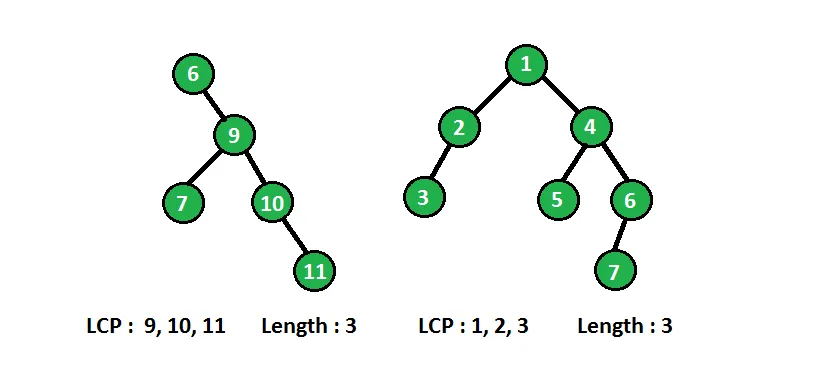
Nous pouvons résoudre le problème ci-dessus de manière récursive. À chaque nœud, nous avons besoin d'informations sur son nœud parent. Si le nœud actuel a une valeur supérieure à celle de son nœud parent, il effectue alors un chemin consécutif à chaque nœud. Nous comparerons la valeur du nœud avec sa valeur parent et mettrons à jour le chemin consécutif le plus long en conséquence.
Pour obtenir la valeur du nœud parent, nous passerons le (node_value + 1) comme argument à la méthode récursive et comparerons la valeur du nœud avec cette valeur d'argument si satisfait, mettrons à jour la longueur actuelle du chemin consécutif, sinon réinitialiserons la longueur actuelle du chemin par 1.
Veuillez consulter le code ci-dessous pour une meilleure compréhension :
C++// C/C++ program to find longest consecutive // sequence in binary tree #include
// Java program to find longest consecutive // sequence in binary tree class Node { int data; Node left right; Node(int item) { data = item; left = right = null; } } class Result { int res = 0; } class BinaryTree { Node root; // method returns length of longest consecutive // sequence rooted at node root int longestConsecutive(Node root) { if (root == null) return 0; Result res = new Result(); // call utility method with current length 0 longestConsecutiveUtil(root 0 root.data res); return res.res; } // Utility method to return length of longest // consecutive sequence of tree private void longestConsecutiveUtil(Node root int curlength int expected Result res) { if (root == null) return; // if root data has one more than its parent // then increase current length if (root.data == expected) curlength++; else curlength = 1; // update the maximum by current length res.res = Math.max(res.res curlength); // recursively call left and right subtree with // expected value 1 more than root data longestConsecutiveUtil(root.left curlength root.data + 1 res); longestConsecutiveUtil(root.right curlength root.data + 1 res); } // Driver code public static void main(String args[]) { BinaryTree tree = new BinaryTree(); tree.root = new Node(6); tree.root.right = new Node(9); tree.root.right.left = new Node(7); tree.root.right.right = new Node(10); tree.root.right.right.right = new Node(11); System.out.println(tree.longestConsecutive(tree.root)); } } // This code is contributed by shubham96301
# Python3 program to find longest consecutive # sequence in binary tree # A utility class to create a node class newNode: def __init__(self data): self.data = data self.left = self.right = None # Utility method to return length of # longest consecutive sequence of tree def longestConsecutiveUtil(root curLength expected res): if (root == None): return # if root data has one more than its # parent then increase current length if (root.data == expected): curLength += 1 else: curLength = 1 # update the maximum by current length res[0] = max(res[0] curLength) # recursively call left and right subtree # with expected value 1 more than root data longestConsecutiveUtil(root.left curLength root.data + 1 res) longestConsecutiveUtil(root.right curLength root.data + 1 res) # method returns length of longest consecutive # sequence rooted at node root def longestConsecutive(root): if (root == None): return 0 res = [0] # call utility method with current length 0 longestConsecutiveUtil(root 0 root.data res) return res[0] # Driver Code if __name__ == '__main__': root = newNode(6) root.right = newNode(9) root.right.left = newNode(7) root.right.right = newNode(10) root.right.right.right = newNode(11) print(longestConsecutive(root)) # This code is contributed by PranchalK
// C# program to find longest consecutive // sequence in binary tree using System; class Node { public int data; public Node left right; public Node(int item) { data = item; left = right = null; } } class Result { public int res = 0; } class GFG { Node root; // method returns length of longest consecutive // sequence rooted at node root int longestConsecutive(Node root) { if (root == null) return 0; Result res = new Result(); // call utility method with current length 0 longestConsecutiveUtil(root 0 root.data res); return res.res; } // Utility method to return length of longest // consecutive sequence of tree private void longestConsecutiveUtil(Node root int curlength int expected Result res) { if (root == null) return; // if root data has one more than its parent // then increase current length if (root.data == expected) curlength++; else curlength = 1; // update the maximum by current length res.res = Math.Max(res.res curlength); // recursively call left and right subtree with // expected value 1 more than root data longestConsecutiveUtil(root.left curlength root.data + 1 res); longestConsecutiveUtil(root.right curlength root.data + 1 res); } // Driver code public static void Main(String []args) { GFG tree = new GFG(); tree.root = new Node(6); tree.root.right = new Node(9); tree.root.right.left = new Node(7); tree.root.right.right = new Node(10); tree.root.right.right.right = new Node(11); Console.WriteLine(tree.longestConsecutive(tree.root)); } } // This code is contributed by 29AjayKumar
<script> // JavaScript program to find longest consecutive // sequence in binary tree class Node { constructor(item) { this.data=item; this.left = this.right = null; } } let res = 0; let root; function longestConsecutive(root) { if (root == null) return 0; res=[0]; // call utility method with current length 0 longestConsecutiveUtil(root 0 root.data res); return res[0]; } // Utility method to return length of longest // consecutive sequence of tree function longestConsecutiveUtil(rootcurlength expectedres) { if (root == null) return; // if root data has one more than its parent // then increase current length if (root.data == expected) curlength++; else curlength = 1; // update the maximum by current length res[0] = Math.max(res[0] curlength); // recursively call left and right subtree with // expected value 1 more than root data longestConsecutiveUtil(root.left curlength root.data + 1 res); longestConsecutiveUtil(root.right curlength root.data + 1 res); } // Driver code root = new Node(6); root.right = new Node(9); root.right.left = new Node(7); root.right.right = new Node(10); root.right.right.right = new Node(11); document.write(longestConsecutive(root)); // This code is contributed by rag2127 </script>
Sortir
3
Complexité temporelle : O(N) où N est le nombre de nœuds dans un arbre binaire donné.
Espace auxiliaire : O(log(N))
Également discuté sur le lien ci-dessous :
Longueur de chemin croissante consécutive maximale dans l'arbre binaire